
-
Mortgage products - On Wednesday 16 September 2026, we've repriced and relaunched our Fixed Rate product ranges across Owner Occupier and Buy to Let fixed rate lending.
-
Our Online Saver (12), pays 4.15% Gross AER on balances of £100+. Apply online today.
"Reform taxes but don't tinker"
Independent Housing Policy and Delivery Oversight Committee advises Chancellor of the Exchequer
Housing Policy and Delivery Oversight Committee urges caution in the face of a dysfunctional market
The independent Housing Policy and Delivery Committee responded to widespread speculation that the Chancellor is considering significant changes to property taxation in the Budget.
At its first meeting, the committee, chaired by former Liberal Democrats leader Vince Cable and sponsored by Family Building Society, identified major topics for further investigation and the data it would study to measure progress in solving the housing crisis.
Sir Vince Cable said:
“There is no doubt that the housing market is not working efficiently, and property taxation is a significant factor. The case for major reform of the whole property tax system – from Stamp Duty Land Tax to inheritance tax to council tax and VAT – is almost unarguable.
“Recent speculation about piecemeal changes in the Budget for revenue raising purposes, if they came about, would be a step in the wrong direction. To take just one example, putting National Insurance tax on landlords would be most likely to lead to higher rental charges.
“That is, in effect, an increase in taxation on working people.
“The reality is that wholesale reform is needed to make the market work more efficiently and achieve improvements in housing provision across the country. This is no small task, and we do not underestimate its complexity or the political dimension.
“Change on the scale necessary demands the most careful consideration and at the least, a white paper and extensive consultation to avoid unintended consequences to this fundamental aspect of society.
“Properly functioning, the housing market can bring great benefits – improvements to the economy, greater labour mobility, supporting skills development and providing more and better-quality housing – to name but a few.
“As an independent committee our aim is to bring a non-partisan, well-informed, critical - but constructive – eye on developments in this vital part of the fabric of the country. It is in all our interests that everyone has safe, well-designed and built accommodation. We are not there at the moment, and we are committed to doing all we can to help the government achieve those aims.”
The committee began identifying the many aspects of the housing crisis which need to be improved and ways in which changes are measured. Key themes included:
- affordability – recognising that the desire to become a homeowner was still very strong
- the impact of the Renters’ Rights Bill when enacted, which is considered by many to be the most significant reform of private renting since the Housing Act 1988
- the challenge of would-be buyers, who are renting, being able to save for a deposit for a mortgage.
- planning – establishing if the latest reforms are having a positive impact
- type of housing – how older people might downsize to accommodation better suited to their needs and the regional disparities in providing affordable homes
- quality of housing – while house price inflation had slowed, the costs of building was still increasing
- contraction in the construction industry with far fewer building firms in the market and SMEs being squeezed out due to financing constraints
- the need for government departments to work together rather than in silos
- local government reorganisation and its impact
- population forecasts
- regional variations.
The committee will initially focus on a select range of metrics including:
- Households and stock
- Affordability - average house prices and affordability
- Need – households in temporary accommodation, those with children, homelessness
- Supply - net additional dwellings
- Existing stock – quality and design.
It will meet every 3 to 4 months and issue reports on its analyses of trends and meeting government objectives.
Committee members include:
- Sir Vince Cable
- Mark Bogard, Chief Executive of the Family Building Society
- The Rt Hon Damian Green, Chair, Social Care Foundation
- Luke Murphy, Labour MP for Basingstoke
- Neil Jefferson, CEO of the Home Builders Federation
- Vicky Pryce, Chief Economic Adviser at the Centre for Economics and Business Research
- Ingrid Schroder, Director of the Architectural Association School of Architecture
- Maya Singer Hobbs, Senior Research Fellow, IPPR
- Professor Tony Travers, a director of the LSE London
For any press queries, please contact Jonathan Haslam at jh@haslamedia.com or Mark Bogard mark.bogard@familybsoc.co.uk
A Call for Integrated Housing - our previous work with the London School of Economics
We work closely with the London School of Economics and have commissioned a series of independent reports exploring the contradictions and perverse incentives inherent in the current policy framework, and put forward a set of suggestions for a more coherent, strategic approach.
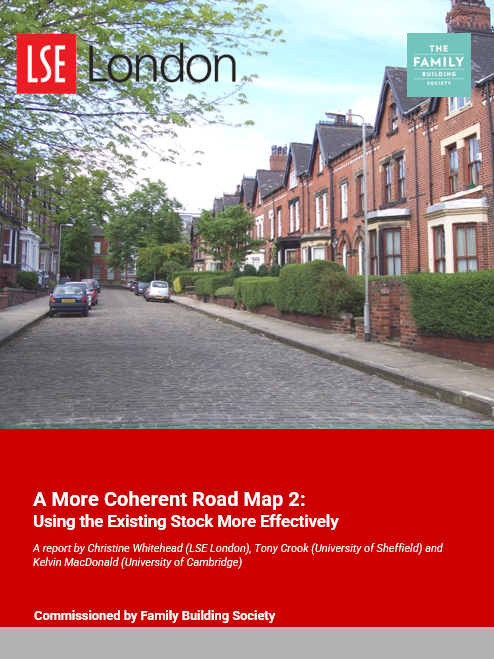
A road map to a coherent housing policy 2 (July 2025)
Our latest report by Christine Whitehead (LSE London), Tony Crook (University of Sheffield) and Kelvin MacDonald (University of Cambridge) cuts through the complexity of housing policy with clear analysis and practical policy action.
The Labour government’s current housing policy has put almost all the emphasis on new build, committing to 1.5 million new homes during its first term. Yet, even when the National Planning Policy Framework is fully in place, it is unlikely that anything like 300,000 per annum will be added to overall housing supply at least during their first term.
With a foreword from the Rt Hon Vince Cable, the authors suggest three quick wins:
- Exempt older households from stamp duty land tax, so they can better afford to move to more suitable housing, leaving more family homes available for families
- Tax second homes and short term lets to bring more homes back into mainstream use
- Treat private landlords like other businesses resulting in more reasonable standard rental housing to accommodate those who cannot currently afford to live separately.
A road map to a coherent housing policy
(January 2024)
'A road map to a coherent housing policy' with forewords by Lord Heseltine and Lord Mandelson, called on politicians, key national and local government departments, as well as the Bank of England, to cooperate on solving the UK’s current housing crisis.
'A road map to a coherent housing policy' noted that there has been a seemingly unending stream of reports, over decades, saying that the housing system is broken. These usually stress a particular problem, often new build, and advocate a solution which would actually change, very little. Without an integrated strategy covering housing as a whole which includes providing housing of a safe and acceptable standard, individual policy solutions are likely to bring very limited success.
Achieving a more coherent and consistent approach to housing policy
(June 2023)
'Achieving a more coherent and consistent approach to housing policy', set out starkly the failure to create an integrated housing policy or to learn the lessons from earlier attempts from major housing reviews since the 1970s. This follows on from our ‘Why is housing policy such a mess?’
This expanded and detailed report highlighted;
- There are too many decision makers
- Housing policy is not fit for purpose
- The right number of homes in the right locations are not being built.